
Board Games
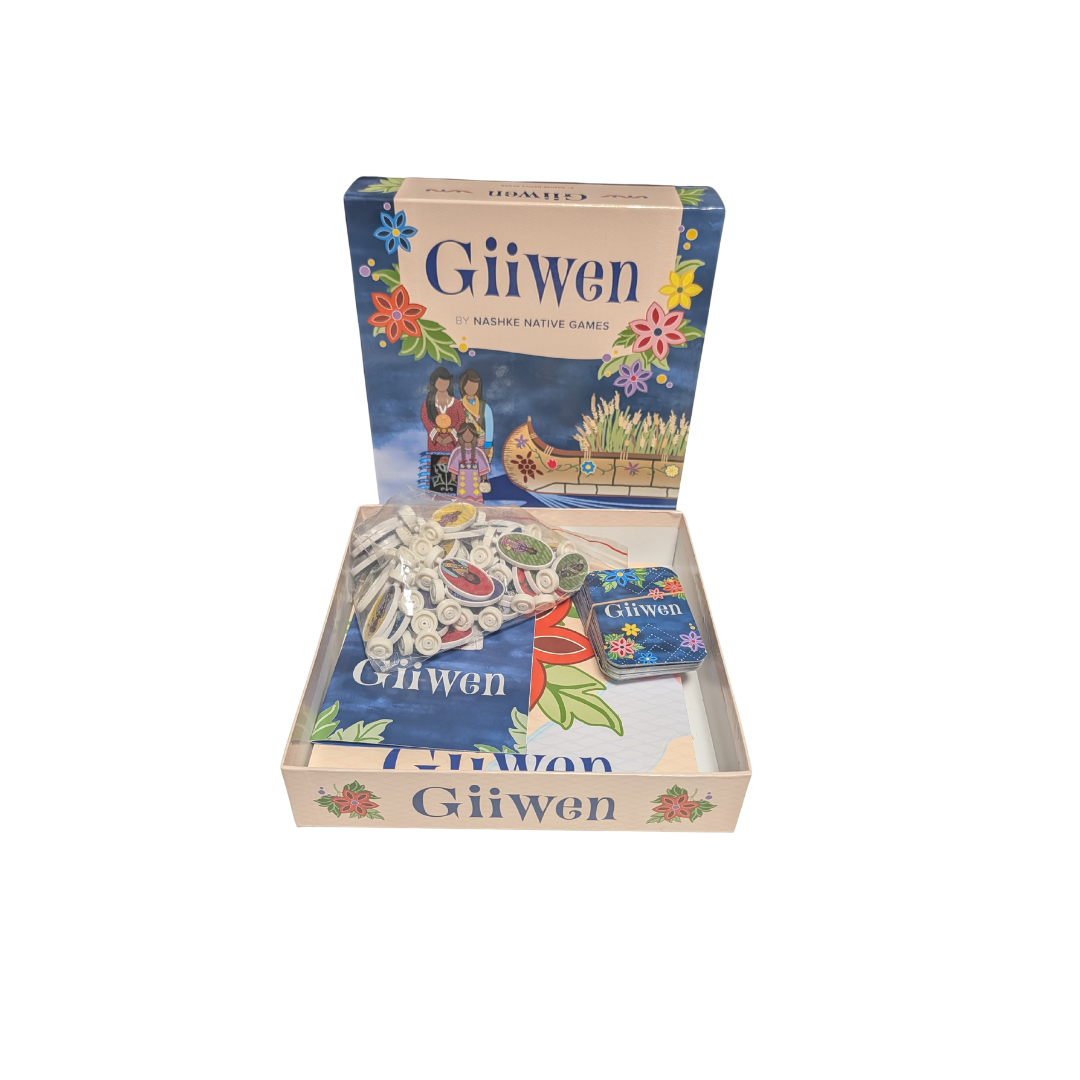
Giiwen (“go home”) is a family-friendly board game inspired by the seasonal movements of the Anishinaabe. Make cultural connections while moving your family members from your wiigiwaam (home) to your waaginogaan (teaching lodge), following the path and letting the cards guide your journey.
Play with up to 6 players in English or Ojibwe. Bilingual cards and language support resources make it easy for learners to build confidence and play in immersion at their own pace.
With simple, chance-based gameplay and optional variations for more strategic play, Giiwen offers a fun and meaningful way to learn, laugh, and play together.
Artwork by Gabrielle Farrell and William “Bill” Brien
Many Native communities have their own versions of hand and stick games. Ginebig is a modern, reimagined game, based on the Ojibwe Snake Game, also known as the Ojibwe Stick Game.
The snake game is a game of chance played by rolling or tossing your “snakes”. Traditionally, the snakes were made of carved sticks or tree roots.
Many different communities and tribes have their own version of the moccasin game. The moccasin game is a gambling game, often played with teams.
Historically, for Anishinaabe people, it was traditionally only played by men. The game was originally played using moccasins. Over time the game evolved to using moccasin tops or decorative mitts. There are a number of different ways to play the moccasin game. Traditionally, each team has a singer, who drums and sings when their team is hiding the marbles.
Part of the game play includes encouraging your team, while teasing and trying to trick the other team as they guess. The scoring of the game can be very complex depending on the community rules. We have created a simplified set of gameplay instructions to engage players of all ages in understanding the Moccasin Game.
This interpretation of the Moccasin Game will be played using tiles, instead of moccasins and marbles/beads. This Moccasin Game is intended as an introduction to the traditional version of Makizinataagewin. We encourage you to learn about the traditional version of this game from an elder or game carrier in your community.
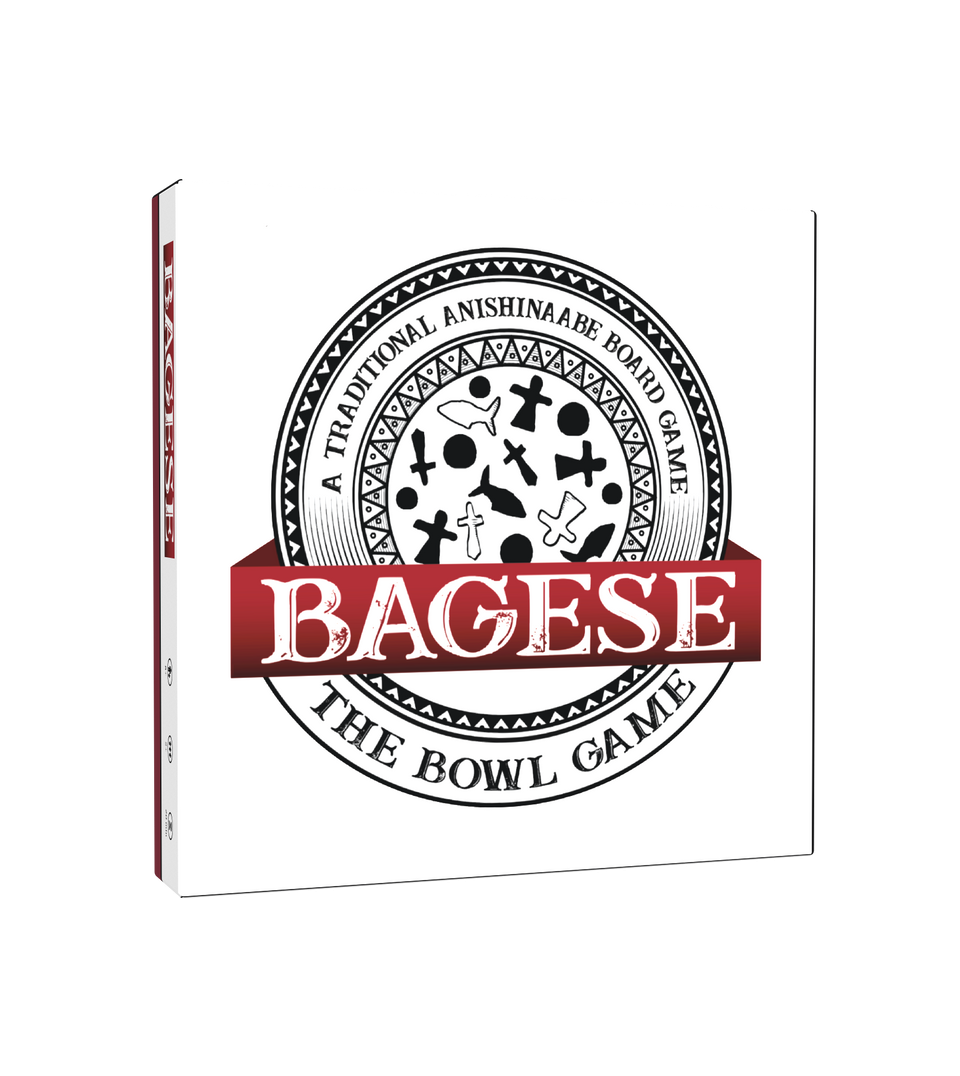
Bagese (or Bowl Game) is one of many Anishinaabe games of chance. The word Bagese is the verb “to throw” in the Ojibwe language. It is in reference to the dice going into the air when playing this game.
Bagese can be played by two or more individuals. Not only is this a game of amusement and gambling, but it in some communities carries spiritual teachings and is brought out at various times to appease those spirits.
Traditionally, Bagese is played using thirteen counters of bone carved into various shapes like men, snakes, war clubs, fish and ducks, along with four circular brass counters. These are thrown from a bowl, and a score is derived from the way in which they fall.
-
“These games are incredible. I can see the benefit to having access for these to all school age children, Anishinaabe or not!"
— Melanie Franks, Tribal Liaison for The Minnesota Department of Education
-
“Your games are fun ways for me to insert my culture, that I know so little about, into my families busy schedule.”
-
“It makes me so proud to see my culture in other places than ceremonies and Pow wows and these games are super fun.”
-
“A friend recommended Mii Gwech to me... and from the first time I played it, I was hooked! I absolutely LOVE it! It's my new favorite game."
-
“I used your games oodles of times. Always met with great success and enthusiasm”
— Jill, Indian Education Advisor
-
“Our students are loving the snake game”
— Jessica, Indian Education, Grand Rapids
Naaba'waagan / Tasiha uƞpi (Bone and Pin Game) is a traditional Indigenous game of skill that has brought people together for generations across Native communities. Also called the “Deer Bone Game” or “Deer Toe Game,” it is found throughout Turtle Island under many names and played in many different ways.
Play solo or in teams with 1–6 players, ages 6+, in English, Ojibwe, or Dakota. Language support resources make it easy for learners to build confidence and play in immersion at their own pace.
Whether you're introducing a new generation to a timeless tradition or rediscovering it yourself, the Bone and Pin Game offers a fun and meaningful way to connect with Indigenous language, culture, and community through the joy of gameplay.
A special thank you to Jim Simas for helping us reimagine and revive this game for our community.
Character art by Jearica Fountain.